
On this page
Why have a diversity policy?
A diversity policy explains your organisation’s commitment to diversity and how you’ll put it into practice. It helps you attract, keep and motivate people from the widest possible pool of talent.
Your policy should cover every level of your organisation, including your board, leaders, people who make art and people in arts support roles.
Step 1. State your commitment
Explain what diversity means for your organisation and why it matters to your work.
Recognise that diversity includes differences in age, disability, ethnicity, gender, cultural or religious background, marital or family status, sexual orientation and gender identity.
Make clear that your commitment applies across your organisation, not just when you recruit new staff.
Building diversity into governance at 4A Centre for Contemporary Asian Art
Here’s a practical example of how you can make and uphold commitments to diversity that reflect the communities your organisation works with.
Building diversity into governance at 4A Centre for Contemporary Asian Art
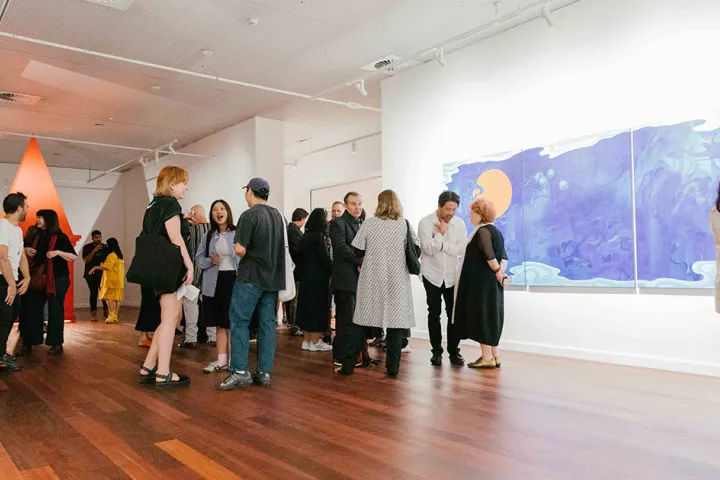
How 4A Centre for Contemporary Asian Art builds diverse voices into leadership, decision-making and everyday practice.
Step 2. Make recruitment fair
Explain how you’ll consider a diverse range of candidates for roles at every level, including board positions.
Review your recruitment and selection practices for bias. This includes conscious bias and assumptions people may not realise they hold. Check that your processes do not unfairly exclude or disadvantage candidates.
Watch this webinar to learn how you can create safe and inclusive environments for diverse board members and employees.
Board Representation: Promoting Cultural Safety and Addressing the Power Gap
Hello everyone. I'm Adelaide Rief, Manager of Leadership Development Programs at Creative Australia. I'm a white woman in my mid-30s with dark brown hair pulled up into a bun, and I'm wearing a black jumper.
I would like to acknowledge the Country I'm dialling in from today. I'm on Gadigal Country, also known as Sydney, and pay my deep respects to the custodians of this place, the custodians of the land, the waters and the sky. I thank and acknowledge Elders past, present and emerging for their care of this Country.
We acknowledge the lands that you are all dialling in from today, and I extend my deep respect to the Elders of those places. I also extend that respect to any Aboriginal and Torres Strait Islander people who are here with us on the webinar today.
This Governance Conversation Series is a collaborative project between Creative Australia and Diversity Arts Australia, designed to explore contemporary issues, showcasing ideas, perspectives and approaches that support artists, communities and those who work with them to thrive.
We are grateful to Diversity Arts Australia for their partnership. Our thanks to Görkem Acaroğlu and the team at DARTS, to our speakers Tasneem Chopra and Lilly Brown, and to the Marketing and Communications team at Creative Australia for making this possible.
Please check out the other conversations in the series on our website. You can find recordings of past conversations and register for future sessions there as well.
Our governance program also includes training opportunities that we are offering in partnership with the Australian Institute of Company Directors. This is open for applications from individuals and organisations. The closing date is 19 September.
For more information, please see the link in the chat and reach out to us via our Leadership Programs contact.
I will now hand over to the inimitable Lena, who will be your host today. Lena, please take it away.
Thank you very much, Adelaide.
I would also like to respectfully acknowledge the First Peoples of these lands and the various lands we are all zooming in from, and to acknowledge First Peoples' ongoing connection to sky, sea and land, and the rich diversity of nations, cultures, languages and communities. I'm joining from the unceded lands of the Wangal people of the Eora Nation, and I pay my deepest respects.
Thanks for attending today's governance conversation titled Board Representation: Promoting Cultural Safety and Addressing the Power Gap.
As Adelaide mentioned, I'm Lena Nahlous and I'm hosting today's conversation. I'm also the CEO of Diversity Arts Australia. I am a middle-aged Arab woman. I'm wearing black-rimmed glasses and an orange top.
Diversity Arts Australia, or DARTS, is Australia's national voice for racial equity. We are pleased to be co-hosting these sessions with the newly named Creative Australia. We are really excited by the ambition of the new body and the work ahead for Creative Australia.
One of our flagship projects at Diversity Arts is the Creative Equity Toolkit, a partnership between Diversity Arts Australia and the British Council, which has also had recent input from the First Nations-led company Garuwa.
The Creative Equity Toolkit supports conversations like today's. It is a practical, action-based website full of resources about topics such as governance and organisational culture, with practical templates and how-to guides. It recognises that equity and governance are closely connected, and that these topics are key to tackling racism and promoting equity.
Today we are going to welcome two people with a wealth of experience, Dr Lilly Brown and Tasneem Chopra OAM, who I will introduce shortly.
I have some housekeeping to get through, so bear with me. I will be as brief as I can.
You can contribute to this conversation by asking questions using the Q&A function at the bottom of your screen. If possible, we may respond to some questions in writing as we go, and we will do our best to make space at the end to answer some of those questions live.
The session is also being recorded. You can watch it again if you do not get to stay for the whole session, or if you want to share it with colleagues. It will be available on the event series page on the Creative Australia website from next week.
The session is being captioned and Auslan interpreted. If you want to turn captions on, go to the bottom of your Zoom screen and select 'Show Captions'. You can change the size of the text in the subtitle settings, or pop out a window to view the full transcript.
I want to thank our Auslan interpreters, Tiana Cramp and Kellie Haggie, and our captioners.
We are going to explore how arts and creative organisations can diversify their boards and overcome historical and structural power imbalances. We hope you get practical strategies, some inspiration and a little bit of blue-sky thinking about what might be possible, because this is a big, weighty and daunting question.
We want to ask how more inclusive structures can strengthen governance and lead to better outcomes for a more equitable arts sector, and for a sector that is robust, strong and sustainable.
These sessions are designed to empower you with the knowledge and skills we need. I believe we have four more sessions after this one.
We will break the session into two parts. In the first part, we will hear from our brilliant guests individually. In the second part, we will have more of a conversation with the speakers, and then some time for questions at the end.
We want this to be a useful and positive session, so we ask everyone participating to be guided by the following values: respect, professionalism and genuine engagement; deep listening; openness; not being judgemental; and trying to make this as safe a space as possible.
If at any time during the conversation you find the discussion difficult or stressful, you are very welcome to take a break and then come back, because conversations about change can be challenging.
Sorry for this very long introduction, but it is important that I also talk a little bit about the Shifting the Balance report, published in 2019. It was a report on cultural diversity and leadership within the Australian arts, screen and creative sectors. It is definitely due for a 2.0, which we have started planning for.
The report surveyed nearly 2,000 leaders from 200 of Australia's leading arts, screen and cultural organisations. At the time, according to the Australian Human Rights Commission, 39% of the population, more than one in three people, were from culturally and linguistically diverse backgrounds. In our research, that meant first, second or third generation.
At that time, Australia Council research had found that people from culturally and linguistically diverse backgrounds had higher-than-average live attendance and creative participation rates in the creative sector compared with the rest of the population.
Despite this, our research found that approximately half of the major cultural organisations in this country had no culturally and linguistically diverse, or CALD, representation at leadership level. Only 9% of nearly 2,000 leaders of our major cultural institutions were from culturally diverse backgrounds. Non-CALD Australians were nine times more likely to occupy cultural leadership roles than culturally diverse Australians.
When we do this research in the future, we will obviously be changing the language, and that is a discussion for another time. But it is important research to talk about, particularly because we know it was one of Creative Australia's motivations for this governance series, and for this session.
If you do not have leadership that reflects the diversity and complexity of the population and the communities in which you are based or working, then it is very difficult to have organisations that genuinely represent those communities and have that connectedness.
That is a little bit of context. We can come back to that, and we will pop a link to that report in the chat, if we have not already.
Now I am going to introduce Dr Lilly Brown. Lilly is a proud Gumbaynggirr woman, scholar, facilitator, director, curator and Executive Director in the youth mental health space. She has spent a decade and a half advocating for the self-determination of First Nations people, including supporting organisations in the arts and cultural sector to develop practices of cultural safety and racial literacy.
We have been fortunate at Diversity Arts to work with Lilly on sustainable governance that centres the critical knowledge and lived experience First Nations people bring to the table. She is a graduate of the Australian Institute of Company Directors, and she has a doctorate from the University of Melbourne and a Masters in Politics of Education from the University of Cambridge. The most profound learning ground for Lilly has been her work with First Nations young people and Elders.
I am going to pass the microphone to Lilly, who will talk about good governance and ground us with some examples. Welcome, Lilly. Thank you very much for joining us.
Thank you. Hello. I am a fair-skinned Aboriginal woman wearing a white and black checked dress, with long brown hair. I am sitting in front of my bookcase, which my partner has beautifully colour-coded.
Thank you for that introduction, and thank you to Adelaide and the broader team. Thank you everyone for joining the session over your valuable lunch break today.
I would like to acknowledge that I am calling from the unceded lands of Broome. I acknowledge Elders past and present, and acknowledge the unceded lands we are all calling from.
In the next few minutes I want to introduce a few principles of governance from my time working with organisations across sectors, in part to support them to be better in their work with First Nations people, but also with all communities.
Before doing so, I thought it might be useful to define cultural safety. What is cultural safety? The concept and practice of cultural safety emerged from a First Nations context. It is Indigenous in its origins. It was first coined by Maori midwives in Aotearoa New Zealand in the mid-1990s.
If we fast forward three decades, it has permeated across the world, particularly in Australia, as something organisations aspire to in supporting First Nations staff, external stakeholders and communities, and all people more broadly, to feel safe in workplaces and in service delivery.
When we talk about cultural safety, or safety, at an individual level, it is about belonging, feeling valued, not having to compromise yourself in any moment, environment or interaction, and feeling like your whole self is reflected back to you in the way a service is delivered or an organisation engages with an individual.
The idea of safety, though, is complicated when the person seeking a service or being engaged with is from a historically marginalised group, or, to reframe it, is not from the dominant group, which in this country, as Lena referred to earlier, is Anglo-Saxon or white able-bodied men and women.
The idea of safety is complicated when you are, say, a First Nations person whose family has experienced generations, or two and a half centuries, of oppression, starting with the concept of terra nullius, which is a concept this nation is founded on. It is the idea that when the British first arrived, this land was land belonging to no-one.
In the eyes of the British, First Nations people did not exist as people. We did not have laws or forms of governance that were recognised according to British understandings of those terms. This is a profound erasure and has implications for the discussion we are having today.
The country was founded on the idea that First Nations people had no laws and no governance. But, in fact, of course we did. We still do. To think we did not, or that we do not, is to deny our humanity, our ways of doing things, our ways of knowing and being in the world. To deny someone, or a group of people, their humanity is to render them inferior or lacking. To deny First Nations people, as a collective, their humanity is the linchpin of anti-Indigenous racism.
We have a lot of work to do because, as I said, this is also the foundation on which this country has been built. When we are having a discussion about First Nations people being meaningfully represented in boardrooms, or to extend that to the value of the Voice in Parliament, we must acknowledge that we have been denied much longer than we have been considered integral to it.
The next question might be: why promote cultural safety and address the power gap at board level, particularly in terms of board representation? Increasingly, there is an appetite to understand how to do better in relation to First Nations people in the arts and culture sector. This is evidenced in the most recent national cultural policy, Revive.
I want to commend Creative Australia on this incredible piece of work, which will no doubt have positive outcomes for First Nations creativity, but also for mainstream organisations that will now be supported to value that. Hopefully, sooner rather than later, this can also be extended to communities from migrant and culturally and linguistically diverse backgrounds, and to communities of colour.
Today's discussion is exciting because governance is the framework or mechanism that scaffolds the way organisations work. It encourages us to understand how the very foundations of our organisations and institutions can more deeply reflect the communities we often seek to represent, work with or benefit.
This conversation is about structures and where power is located. We get to talk about who makes decisions in institutions and organisations, and who informs those decisions. At the centre of that discussion is how to strengthen the structures, which is always exciting. Innovation in this way is always exciting.
A principle that underpins the work I do is that if you can get what you do right in relation to First Nations people, then your work with all people will inevitably benefit.
The third bigger question, again in the context of today, which is also the first question you need to ask yourself as individuals and as individuals representing organisations doing this work, is: why be a culturally safe organisation at all? I am not going to answer this because it requires a nuanced and complex answer, which I think will emerge strongly over the next hour or so.
Quickly, I want to share some principles that I feel are real enablers of success when you are seeking to shift the structures of your organisation to better reflect the communities you represent and seek to benefit.
The first principle is reframing mitigation of risk as community accountability. When I work with organisations, whether a football club, a mining company, or an arts festival organisation, for example, that are in crisis for doing the wrong thing in relation to First Nations people, particularly where it has escalated to board level, the most common response is: how do we minimise what has just happened? How do we decrease the reputational, financial or legal risk?
This is often underpinned by the corporate governance idea of risk mitigation, which can alienate or compromise First Nations communities. A more productive approach is for that board to ask: who are we accountable to?
In fact, if you have a First Nations board member, this is often what they will be asking. It is usually the reason they are on the board: to help that organisation be more accountable to First Nations people and communities. They will be asking: how can we, or this organisation, be accountable to First Nations people?
Instead of framing everything in terms of risk mitigation, try asking: who are we accountable to? Then proceed from there. Often the action will look different, but in the long term it will strengthen the relationship with the communities you are responsible to.
The second principle is supporting people to value relational ways of working. Ethical relationship-building is action in this space. As my incredible friend Jason, who is a Wiradjuri man, says, things in this space move at the speed of trust. Trust is built through relationship-building.
You cannot have trust if that investment is not made in creating a strong and meaningful relationship with the community you work with. This does not just apply to First Nations people. It applies to all communities.
In a corporate governance context, transactional ways of working are often valued. You can see that in operations, where sending an email and getting a timely response is often perceived as a positive way of working. But if you are going to send an email to an Elder, you are probably not going to get a response.
If you want to work in terms of First Nations governance and relationship-building, you have to pick up the phone. You cannot just count on a five-minute conversation. You have to settle in. You have to talk to that Elder about everything else going on in their life before they are willing to give you their time and energy, because that is so valuable.
The third principle, and this is the last one before I hand back, is that goodwill is not a resource. Goodwill is needed in this work, but for cultural safety to be embedded in your organisation, it has to be understood as part of the fabric of the way you do things. It cannot be the responsibility only of culturally capable or well-meaning individuals.
Quite often it is those culturally capable and well-meaning individuals who reach out to us, to myself and my colleague Genevieve, when we do this work, and say, 'We need your support.' If that individual is not supported by management, leadership and the board, they burn out and leave, or they invest all this time in incredible initiatives that never actually get up off the ground.
For First Nations people to be culturally safe, there must be spaces and workplaces scaffolded by policies and processes that are not racist. When I say this, I am not only talking about interpersonal racism. Racism is interpersonal, but it is also institutional and structural.
As I said, for two and a half centuries, knowledge and stories have been devalued, and our existence has often been denied. This is the very foundation of Australian nationhood. For cultural safety to exist, it is not only about the relationships between individuals or the conduct of individuals. If culturally safe practice is located only there, then when that individual leaves, cultural safety leaves with them.
If you are committed to the cultural safety of First Nations people, and all people, it has to be embedded in policies, processes and all levels of the organisation, including at board level. That's it from me, Lena. Over to you.
Thank you very much. That was fantastic. There was so much to think about. You did it in 10 minutes, which was incredible, and managed to put so much knowledge and so many important concepts into that time.
You spoke about reframing risk mitigation by asking who we are accountable to, and about the importance of trust and ethical relationship-building. You also spoke about how important it is not to see racism only at the individual level, but also at structural and systemic levels.
If we are going to do this work of changing boards, or bringing more diversity to boards, we also need the scaffolding of policies, procedures and actual structural change. I know I have not encapsulated everything you went into, but there is a lot for us to unpack in the second part of the conversation. Thank you very much for that.
Thank you, Lena.
I like that, and maybe we can talk more about risk mitigation and community accountability a little later.
I want to now hand over to Tasneem Chopra OAM, who is a cross-cultural consultant addressing issues of diversity, equity and inclusion through an intersectional lens within government, corporate, arts and community sectors.
Tasneem is an anti-racism champion for the Australian Human Rights Commission and has been awarded a Medal of the Order of Australia. Tasneem is a strategic adviser to the Victorian Public Service Commission, Fire Rescue Victoria, co-chair of the NSW Legal Aid external anti-racism and inclusion committee, and an ambassador for Women of Colour Australia.
She is an outgoing board member of the Australian Centre for the Moving Image, or ACMI, the Collingwood Football Club expert panel on anti-racism, Ambulance Victoria, and former chair of the Muslim Women's Centre for Human Rights. She is also a former curator at both the Immigration Museum and the Islamic Museum of Australia and hosts the podcast Strengths Unfold.
There is more, but I am going to hand over to Tasneem now. She has a lot of experience being engaged on boards, and she is going to talk about some of the critical issues in relation to this conversation, including whether it is possible to create culturally safe boards if you are the only one, for example. Over to you, Tasneem.
Thank you. Thank you very much, Lena. Thank you to Dr Lilly Brown. There was so much to unpack and so much valuable knowledge.
My name is Tasneem Chopra. I am a middle-aged woman of Indian descent, living here on the unceded lands of the Wurundjeri people of the Kulin Nation in what is known as Naarm, or Melbourne. I am wearing a teal turban with a teal jumper and spectacles, which I think are burgundy in their rim colour.
My gratitude for being part of this panel to discuss topics that, in many ways, intersect with areas of great interest and passion for me, personally and professionally.
Art is something I hold dear to my soul. The work I do is necessary in the space of social impact, and for that reason I find the deficit of leadership that represents the communities that will benefit, and whose stories are not necessarily being represented, a great source of frustration. There just is not enough there.
As Lena alluded to earlier, I have had board experience providing governance advice at various levels, and some boards have been relevant to the arts industry. There is definitely an intersection where I am able to apply both my lens of cultural diversity and governance. It has been an interesting journey. I have a lot of feelings about what that has been like and a lot of opinions about how I think the entire environment can improve systemically and seismically. There is a lot of change to be had.
If we know that structurally and systemically the inequities that trickle down to communities are known in Australia and have been since colonisation, then they are embedded in what we experience. There is a certain dominant template of what the industry should look like, and presumably what the audience for the industry looks like. For me, the premise is flawed.
Once you start dissecting the demographics of who we are, where we are from, and what kind of political lens is used to infuse the content of media and art, then through my experience you can start to see what is actually going on.
To be that one person of diverse background on a board and try to rattle things, and be the 'professional disrupter', as I have sometimes known myself to be, can be a lonely journey. There are small wins, but not seismic ones, because you feel like you are chipping away at a mammoth task of making institutions see the broader picture. For me, that is the great frustration.
Having said that, the small wins I have enjoyed include being able to table something as simple as: what is our cultural diversity strategy for this organisation? Do we have one? In non-arts organisations, I have seen that conversation received warmly because nobody was even talking about it until I brought it up.
The danger is that you then become the emblematic representative of all things diverse. You are seen to be the pundit on all questions relating to cultural diversity, Indigenous communities and everything that is not, as they say, pale, male and stale. That is not sustainable.
Cultural competency training, to me, is a given. Making the organisation sit with the discomfort of knowing that the way they have been doing things, and perceiving audiences and workforces as a monolithic entity, is problematic, because we are diverse. Even within diversity, diversity is not homogenous. Diversity is diverse by definition.
It does not stop with gender. That tends to be the go-to for too many institutions in this country. Somehow they feel that if they are tracking on gender equity, that is sufficient. It is essential, yes, but not the complete picture. There is more to be done.
Particularly within the arts, I am seeing such a deficit. The domination of boards and governance levels in this country by people who are not representative of the demographic of the audience and population we have here is a major missed opportunity.
How do you plan or set an agenda for an audience you do not have any proximity to? Almost 50% of us are either born overseas or have a parent born overseas. That diversity not being reflected in leadership within organisations is going to have consequences. It is having consequences in terms of the content you develop, the markets you reach and the impact you have.
We know how powerful the arts can be as levers of social change, in touching hearts and minds and influencing change. But if that capacity to make change and increase awareness and knowledge is strategically managed not to represent all of us, then to me that becomes political.
I have seen the development and emergence of work on the fringes thrive in small doses, and that is probably where I go to get my arts fix, so to speak, from practitioners and creatives who have to work outside the mainstream because the mainstream either does not see them, does not believe they are worthy, or certainly does not fund them. More often than not, it is invisibility.
Having looked critically and been in the sector for the last 10 years, I have found there is almost a system and culture where those who have the talent and ability to provide diverse content, designed by community for community, are excluded from the opportunities that mainstream systems create.
By definition those systems are coded and privileged. When opportunities exist for one to enter the other, people may lack the right tonality, fill in the funding form differently, or not have the right sponsor or the right name. If they are lacking the unspoken but necessary nuance to be advanced, they fail to benefit.
There are exceptions. There have been examples in maybe the last 12 months where I have thankfully seen diverse creatives get up. But it is still 5% in a pool that should be at least 50. There is a long way to go.
I think there is education to be had on both sides. Mainstream arts organisations need to recognise the privilege they have in providing opportunities, even through funding rounds, that somehow only privilege and target those who are familiar with the system and know how to complete the application forms, which can be so prohibitive.
If you do not understand the language of the form, you will fill it out incorrectly. You will not necessarily provide the right objective, aim or vision statement, or whatever is required. That is in no way a reflection of the product you are going to deliver. It does not correlate with the talent you have. Yet because you miss one set of metrics, you miss out on the overall benefit. I have seen that play out again and again over the last five to 10 years.
The question I would have for funding bodies is: rethink the way you approach the public when it comes to issuing grants. Who is this form set up to benefit? If it is going to attract a potential applicant who has the resources to pay for a grant writer, compared with an emerging community that does not have those resources and does not even know a grant writer exists, you have already created an uneven playing field before you start.
That level of inequity continues from the application process, to the assessment process, and ultimately to whether funds are allocated. The system is broken. We need to rethink how we engage and who we engage.
That can start to happen when the people making decisions about how things will run reflect the communities they are trying to serve. That is where leadership, and diversity in leadership, can be of benefit.
But when you are the sole person on that organisation or board, and you feel isolated, I have seen and heard from colleagues in similar positions that organisations will retain you and think they have done the diversity win because they have the brown person at the table. But that person can be quite isolated if they are not supported in new thinking and new ideas.
You sit with your imposter syndrome. When you want to raise an issue that is counter to what everyone else is saying, or you are brave enough to raise it but there is no-one else to second or support you, it can chip away at you. It takes enormous strength of character to continuously say, 'I disagree. I really want to push for this. I am standing by my position', without raising eyebrows or hearing, 'There she goes again.'
I am so sorry. I could listen to you all day, but I have to let you know that you have about 30 seconds.
Creating environments on boards where people can come on and then supporting them once they are there is important. Providing the infrastructure to support people from diverse communities to be on boards, and not just accepting that once they are on that is it, but sustainably providing culturally safe environments, speaks to what Lilly was saying about beginning the process of change.
Fantastic. Thank you. I like the title 'Professional Disrupter'. You and Lilly both spoke about the importance of changing systems, and that it cannot just be about bringing in individuals. It has to be about systems change.
There was a lot to unpack there, which I think we will do in the conversation. We are going to talk now about practical steps for introducing more diverse and inclusive boards.
The first question is for Lilly, and follows on from what Tasneem was talking about: culturally unsafe boards. Lilly, you gave us a fantastic education on what cultural safety is. When people talk about culturally unsafe boards, what do you consider to be a culturally unsafe board?
Reflecting on what Tasneem was sharing, boards are increasingly doing better at identifying positions for First Nations people, and then that becomes the action. Inviting someone onto the board becomes the signal that the organisation is progressive in relation to First Nations matters.
But if that is one of the only actions the organisation has taken, what they are doing is passing an incredible cultural load onto that individual. That is one of the ways a board can be culturally unsafe.
If the cultural burden rests with First Nations people and, in parallel to recruiting someone to diversify a board, the cultural capability of other directors has not been built, that will always lead to a culturally unsafe board. It is almost like forcing an individual to be the radical, because they will always have to dissent when decisions are being made in relation to First Nations people or people of colour.
It will always be them raising their hand to say, 'Hey, this is not right', if the decision being made is not for the benefit of those communities. Whereas if you have a culturally capable, or more culturally capable, directorship or collective of people, then it becomes a shared decision-making process. You have a collective group with a shared language and understanding. They are informed. That is their duty as board members. If you are making decisions, you should be informed about them.
Quite often the load becomes the load of the First Nations person or person of colour. That is not okay.
When we talk about scaffolding boards to be culturally safe, and we talk about the axiom that the culture of an organisation starts at the top, if these things are happening at board level, I absolutely guarantee they are also happening across the organisation.
Boards need to get it right. They need to understand that it is not just about having a bum on a seat. It is about supporting all directors to understand the importance of the work. Then the work is not exceptional. It should not be exceptional. This work should not be exceptional. You should not have a First Nations director as an exception to the rule. You should have them valued as part of the fabric of the organisation.
To do that, you need to understand the implications of this work for your policies and processes. Coming back to the First Nations-specific context, as First Nations people we often talk about how we cannot, as individuals, represent the diversity of our communities. It is impossible.
If you have a First Nations person on your board and other directors who have not caught up, what other mechanisms are you going to put in place to ensure the director is not burnt out, and to ensure whatever decisions you make are implemented in a sustainable and meaningful way? One way you can do that is to pay First Nations people to be on advisory bodies to the board.
There are stopgap measures you can put in place while the board works to make itself culturally safer. The board will never be completely culturally safe, but it can become culturally safer. That is the aspiration.
Thank you very much. Tasneem, you have spoken about being the only one on a board. This is very relevant to people of colour, being the only one and feeling almost obliged to represent everyone.
You spoke about the importance of training and education, but what other structural changes or practical actions can boards take to work towards making culturally safer spaces? As Lilly says, we can never guarantee cultural safety, but we can work towards creating culturally safer boards and organisations.
I should start by saying I do not think I have ever nodded so much as I did when Lilly gave her response. I feel like I need a neck massage at this point.
Beyond one-off cultural training and appointing the brown person to the board, there is the idea of applying a cultural diversity matrix across everything you do. It is not just when you have a function. It is: how do we recruit? How do we retain? What are we planning for? Who are we engaging? What does our market strategy look like? In all those areas, the lens should be consistent.
It should not be a one-off. It should not just be for Hanukkah, Eid or Christmas. It is about being consistent in that lens and embedding it into business as usual, not as an afterthought, but in how you operate.
Spot on. We have been working with organisations over the last few years, and we have worked a lot with Garuwa to develop equity action plans. They can have different names, such as justice equity action plans, and they are about embedding changes and structures across all areas of an organisation, from audience development to community engagement to governance.
You need practical goals and targets to do this work, and to hold yourself and your organisation to account.
I should add quickly that when we make that ask, it should be done in tandem with having people and resources within an organisation who are representative of the communities.
It is much more intuitive to get the tone right, even for initiatives targeting all communities, including diverse communities, when there are diverse people involved in the board, marketing and outreach. When the people doing the engaging are representative of the people you are trying to engage, it is not rocket science. You get it right. You get the tone right.
Co-design is simply what this is. It is ensuring that whenever you are creating and promoting a product, if your workforce is representative of the target group, then by definition you are building co-design into that process.
That makes sense. Australia is a rarity in that when I have sat on panels internationally, people are often shocked by the number of people who do not have lived experience, but who are consulting on issues such as disability, cultural diversity or First Nations matters.
Lilly, I was once told, when I was advocating for more cultural diversity on a particular board, that they just could not find anyone in the entire state from a person of colour or migrant background who had the expertise and connections needed to be on that arts board. I have to laugh, but how do you feel when you hear organisations say, 'We just cannot find anyone with the experience from a First Nations background or a diverse background to join our board'?
For me, as an Aboriginal woman, when I know that we make up 3.5% to 4% of the population, of course there is a capacity issue. But in that comment there is also the assumption that First Nations people, people of colour, and people from refugee and migrant backgrounds do not have the knowledge, experience or skills to do the work.
What that does is value qualifications over lived experience, and that is a problem. But also, we do have the qualifications. I have a bloody Masters from Cambridge, and I know a lot of other First Nations people who are absolutely up-front in terms of their black excellence. They might or might not have qualifications, but they are overqualified to be on most boards, to be honest.
It is not our issue. It becomes the organisation's issue. They are employing frameworks of understanding that limit what they can and cannot see. That is their loss.
As First Nations people, we are asked to do a lot. We are a very small proportion of the population. Organisations need to find sustainable and meaningful ways to engage with us as individuals and communities. But to say that we are not qualified is no excuse. That is not an excuse.
Tasneem, did you want to add anything to that?
Yes. High five. Decolonise the skills matrix. Proximity to whiteness is not the win. It is substance over style.
There are so many ways in which we predicate what the right fit is. We are so obsessed with cultural fit that we forget the value of cultural add. Think about diversifying your thought processes by diversifying your table.
Think outside the square when it comes to recruitment. So much of the problem is HR in organisations that are inherently not diverse, making the choices. Start diversifying HR and you will see diversification in recruitment and who is recruited.
As long as it looks the same, and has a very vanilla structure and a hiring framework from 1953, of course you are not going to get a diverse cohort. The problem is who is at the table.
Adding to that, what Tasneem said speaks back to what you were saying about grant applications. If those frameworks are being used to identify who is or is not available to be on a board, and then they are extended to who is or is not valued in terms of grant applications, it is very obvious that the culture of that organisation has been set at the top.
What that excludes in practice, in terms of what is valued and not valued, is a real loss. It is not just a loss for the organisation. It is a loss for audiences. Not just black and brown audiences, but all audiences, who should be able to access the beauty of that. It is a shame.
Yes, because if we are going to have a sustainable and robust sector, then it is all audiences and all communities. It is that connectedness that is so important, and that only arts and culture can do.
I feel like we may have already answered this, but I think we have already talked about how organisations can reduce barriers that have locked out historically marginalised communities. Would you agree, or is there more we want to say about that?
Yes. Very practically, and I think there is increasingly a deeper understanding of the importance of this, you have to pay for lived experience.
Yes. Why do arts boards not pay? Why do we not pay? Yes. Okay.
In a way, I think the arts sector is commendable. There are so many people slogging it for not much money. It is an issue, and we do not want to legitimise that. It is an extension of successive governments devaluing the arts and culture sector.
People need to be paid accordingly, and that needs to extend to the diversification of boards. Quite often, when you have diverse board members who are not coming from intergenerational wealth, that money is important. What that enables is sustainable engagement.
If you have Elders or community people who do not have access to that capital, supporting them financially is one of the most practical things you can do in terms of diversifying your board.
The way we approach community-led knowledge and information has a hierarchy. We need it. Without it, we cannot produce the work. But we often would not pay for it because it is community knowledge. It is the idea that by giving us your knowledge, we will be able to help your people.
At the same time, organisations would remunerate a consultant very well for the same information, and that consultant would probably go to community to get that information anyway. So the system is skewed to privileging those who have greater proximity and resemblance in background to leadership.
I am saying this as a consultant. I know. As a consultant, I will get paid to do something, but when people want my input through a cultural lens, it is considered that I am doing my community a favour. It is racist, really.
So much wisdom, and very practical as well, about needing to remunerate people and rethink that. It is a barrier to a lot of people who, as Lilly said, are not necessarily wealthy and do not necessarily have the time to do the amount of work required to be on an arts and cultural board.
I think we will go to our final topic, unless Tasneem, you wanted to say anything else about ways of reducing barriers?
I am happy.
Our final topic and question is about what needs to change and shift for boards to be more inviting spaces. I think we have already addressed that, but we are hoping this will be a little bit of a blue-sky question.
We can spend time with it so it will be inspiring for people on boards, people aspiring to be on boards, people responsible for recruiting for boards, and organisations wanting to build more robust and equitable organisational cultures and structures.
We are going to talk about what needs to change for boards to become places where people from diverse and historically marginalised backgrounds would be knocking at the door saying, 'We want to join your boards.'
Tasneem, I will start with you. If you can imagine this amazing future where we have decolonised boards and structures of organisations, and the way we operate, what would that look like? What would it look like for people from historically marginalised backgrounds to want to join boards, to feel valued on boards, and not to feel exhausted, which is often what we hear when people from under-represented communities join boards?
If we are looking into the future through a utopian lens, I would say you would not be the only person of colour on the board. There is that.
You would be in an organisation that had a cultural diversity strategy, cultural competency training as a given for all members, including those from diverse backgrounds, a record and commitment to providing culturally diverse content as core business, not just on special occasions, and cultural safety plans in place for all members.
Beyond that, you would see diversity bleed through the organisation: entry level, middle management and senior levels, not just entry level, which it tends to be. You would see yourself reflected throughout the organisation, both in terms of the people and the content it delivered.
Does that resonate with you, Lilly?
It does. When I imagine a best-case scenario, you have people of colour and First Nations people on boards, and they are not there for that. They are on mainstream boards and they are there for everything they bring. Most Aboriginal people also have a degree in accounting or other skills to bring. We are complex humans.
Quite often, marking us as particular bodies or lived experiences denies that complex humanity. As intersectional beings, none of us is just one thing. Yet sometimes when you are pegged as one thing, the rest of you cannot be valued in that context.
When I talk about racism, I am really talking about the way it functions structurally and institutionally, as well as interpersonally. Sometimes it is too easy to locate racism in the interpersonal because it is very visible there. What we need to attend to is how it functions institutionally.
To deny someone their full complex humanity is textbook racism. When you have structures that enable that, that is a problem. So it is about breaking down those structures and saying, 'You have these extremely diverse boards that really reflect the communities arts boards are seeking to represent and work with.' People are not diversity hires. They are there because of their full complex humanity and the skills they bring in addition to lived experience, which is what is afforded to other board members who are white, able-bodied and quite often men.
If we are valuing the beauty of diverse communities, that needs to be reflected across the organisation and valued. It is a no-brainer. For it not to be valued is a problem. So let us start valuing it. What does that mean? It means resourcing. It means moving this work beyond the exception and normalising it as part of the practice of an organisation.
When people do the work, they are just doing their jobs. It is part of the KPIs or part of their position description. When we talk about decolonising the skills matrix, imagine if it was not just: what are your financial capabilities, and what are your connections across the philanthropic sector? Imagine also asking: what is your sensibility in regard to advocating for Aboriginal and Torres Strait Islander people and other diverse communities?
That question is asked not just of non-Indigenous or white board members. It is asked of Tasneem and it is asked of me. If we are extending a framework in which the lived experience and full complex humanity of board members is understood, then people will also understand that I might be able to speak as an Aboriginal woman who belongs to Country, but I cannot speak for those in far north-east Arnhem Land. There is violence in thinking I could.
What does it look like for us to come onto these boards and be valued in everything we are?
Have there been examples of really good boards or structures, or alternative boards that you have both been on, where things have worked well?
I had the opportunity on one board I was on in the past where the board was invited to participate in a program called the Board Observership Program. Some people might be familiar with it.
It is a pathway for people, I think between the ages of 25 and 40, predominantly younger than traditional board-aged people, and it skills them up on what to experience and prepare for when sitting on a board. It is not the Australian Institute of Company Directors board course, but it is something in parallel that I think is more affordable and accessible.
The idea is that people participate in a program that runs, I think, over about 12 months, with support from their employer at the time. At the end of the program, they get an opportunity to apply to sit on a board of their choice as an observer.
My interaction with the entity running the program was that they approached me not because of the board I was on, but because of the work I do in cultural competency. They said they recognised they did not have diverse participants and wanted to change that. It was obviously well intended. They wanted me to promote their initiative to others, and I was happy to do that.
In the process, I found out in subsequent years that people I recommended or referred on did apply, got through and got onto a board. One of the benefits of the observership program is that at the end of your term as an observer, the board has the opportunity to retain you. So you can be fast-tracked onto a board and get that experience.
In some cases, I saw that happen. Again, it was few and far between. I appreciated the call-out from the training body asking me to share this with my people, which I was happy to do, but I am not the solution to diversifying approaches. I do not have all the people's numbers in my WhatsApp group. I can only provide it to people I know.
It was a start, and it was great to see. I am no longer with that particular board. I have seen and know of participants from diverse backgrounds who have been through that program and said, 'If I did not know, I would not have got on. I could not have been on a board in my 30s.' They are the only person of colour on the board, and I think, let us hope they can stay on the board and that there is some culturally safe environment at play. It is a new iteration. Let us see how it goes.
For me, I have the privilege of being on boards of Aboriginal community-controlled organisations. Quite often, those boards are made up of Aboriginal people and non-Aboriginal allies. When I think about cultural safety, being on the board of an Aboriginal organisation where corporate and financial governance are overarched by cultural governance is a real pleasure.
I front up, but all the other parts of me are recognised. More than ever in that board meeting, I am just like: I am a woman, or I am a mother. Because what is normalised is being a First Nations person, that is not the thing that is focused on. It is a real pleasure.
On one of the boards, we have the most exceptional non-Indigenous accomplices who would fulfil the dream matrix. In their conduct, you can tell they feel privileged to be in the space. They feel privileged to be on a board where First Nations is first, and as non-Aboriginal people they are contributing to strong functioning corporate governance.
What that tells me is that this is transferable. If First Nations organisations can have really strong functioning cultural and corporate governance, then that can also occur in mainstream organisations. Mainstream organisations just have to begin to understand and articulate what cultural governance looks like in that context.
There is nothing more beautiful than having a board meeting out on Country, to ground yourself and connect, and to see that relationship-building is action. What happens then is that you have a strong and formidable board that can tackle extremely tricky issues and still be standing at the end of it, because conflict is generative when those important foundations are in place for how we engage with one another.
In corporate governance, that is absolutely not valued. If cultural governance is not articulated in a boardroom, not just First Nations cultural governance but cultural governance more broadly, such as the culture of the organisation, then relationship-building as action becomes exceptional. I keep saying that because in corporate governance, when those things occur, it is by accident. It is not by design.
How do we ensure that boards function in a way where these things are not accidental? You have chairs who understand that board members knowing each other, not just at a boozy, expensive dinner the night before the board meeting, but in the board meeting and in the moment, supporting one another and getting to know one another, is a key ingredient to safety. Not just cultural safety, but the safety of everyone.
It also moves away from the idea that to be professional you have to be composed and cannot let too much of yourself into the room. I often think about the idea of conflict of interest. Everyone knows everyone in the Black community. There is rarely a time when I can be sitting in a corporate boardroom and not know someone.
That is reality. In a corporate context that is framed as a conflict of interest. How do we ensure these things can still exist while maintaining good probity and good corporate governance, but also informing the importance of relationships, ideas of safety, diversity and beauty?
It is about shifting the way we do things and understanding that corporate and cultural governance do not have to sit in tension. They are functioning all across the country in generative ways, including in our Aboriginal community-controlled sector. We have beautiful organisations like Magabala Books, which was mentioned in the Revive policy. They have an all-Aboriginal board, a non-Aboriginal CEO and incredible non-Indigenous accomplices supporting the work they do.
This is generative work if we can get it right.
We have a lot to learn from the way First Nations boards are set up, and how we can take those approaches into other spaces and board structures.
We have a question. It says: 'It is unpaid labour. It is not fair that I have to consult and share my connection and lived experience. Why is it standard and expected that board members are there in a voluntary capacity?' I might hand that to Tasneem.
If you are talking within an arts context, I have had the same conversation myself in the past. Why is this not paid? In other government or government-funded convening spaces, board representation is paid. The answer is often literally: this is how it has always been, which is the answer to so much in this country.
If I take a deeper dive, it comes back to the devaluing of the arts. It was not long ago that governments in this country radically defunded the arts because they do not see the value. If they do not see the value of funding arts, how are they possibly going to see the value of funding an opinion about us? I am not being cynical. I think that is why there is a legacy culture of not funding or remunerating that kind of advice.
In any other capacity, I can assure you that if you were advising on aspects of emergency services, infrastructure, education or defence, you would be paid. Maybe someone else can answer that. That is all I have.
I do not know if I am less cynical, but historically, if we think about who sat on boards, more privileged people have been able to sit on boards and not be paid. Now we have the push to diversify boards, and what that means is that you have to pay people. It is again that goodwill. Benevolence is not a resource, but previously it has been.
You have people from corporate sectors sitting on small arts boards because it looks good. It is a good way for them to exercise or demonstrate their support of community or volunteering. But we know, and more and more the discourse says, that even the volunteering sector is unequal, because to volunteer you have to have the resources to do so.
So true. Absolutely true.
The more we move to diversity, the more we have to think about what enables that. How do we enable it? I feel very privileged to be on this call, which has been facilitated by one of our main funding bodies for the arts and culture sector. If this beautiful piece of policy is actually going to be implemented, these are serious questions we need to ask.
If we are going to diversify, how are we actually supporting individuals to sustainably be in these power-holding positions? It needs to be part of it.
It is interrelated. When you have board members on seven-figure salaries sitting on a board because they enjoy the arts, love it and are philanthropists, that is great. But then you have a single mother from the outer suburbs who is not in that position, and having an unfunded position on the board can make the difference between joining or not.
That will trickle down to what informs content, conversation, direction and policy. Start remunerating the positions because it is going to attract talent that will diversify your content and your bottom line.
That is not happening. Historically, the people sitting at the table for an arts entity have been privileged and enjoy it. They come to it with good intent and love the arts. But it is not about shifting the needle. It is about embracing more opportunities for their cohort, friends and sector. That is not representative. It is problematic. I have run into that through multiple experiences, being the one person who did not look like the rest or come from the same background as the rest.
If you are in a salaried position and your employer supports you to be on a board, you can be on that board and not have to be paid. It is part of your job. But in the arts and culture sector, if we talk about lived experience beyond the colour of your skin, it is also rare that someone can commit to full-time creative work and be sustainably paid.
Right now, to be creative and to want to be paid for it is precarious. It is precarious labour, and it needs to be addressed. Again, this is when we say that if you can get right what you are doing in relation to First Nations people or people of colour communities, then it will benefit everyone. It benefits everyone.
Lilly and Tasneem, how can we bring the principles of justice, equity, diversity and inclusion to the agenda of every board meeting so that it is actually in the DNA of the organisation and embedded?
Boards are known for adhering to skills matrices quite enthusiastically. Maybe we can decolonise the skills matrix. As I mentioned earlier, what kinds of cultural diversity are you embedding as core within the way you recruit board members? How are you going about it? If you are not getting it, why?
Going back to HR and marketing strategies, how have they historically been sourcing their directors? Has it been from the standard AICD group chats, or are they doing something more creative? Who could they lean on to think outside the square? Is it Diversity Arts Australia?
It is about putting in their heads that the way they have been doing it is not sustainable in the long term if Australia is advancing in its demographics but they are not advancing in the way they plan, set agendas, create content and approach people and culture.
I agree. If we talk about the culture of organisations, there is also the culture of boards. If we are talking about principles of justice and equity, then the culture of the board needs to align with that. If that means some people need to step down, then that is a conversation that the board needs to have, because quite often people do need to step down if you want to bring someone on.
It is about setting a benchmark that includes board members understanding what decolonisation is, and understanding what racism is and how it manifests interpersonally, structurally and institutionally, given boards are structures and institutions.
If you want to be effective board members at this organisation, you must understand that, because we are going to be implementing a cultural strategy or doing work in the First Nations space. To do that successfully, we need a board that is fit for purpose.
Actually reviewing the board and asking, 'Are you fit for purpose? What are you here for?' If it is because you enjoy the arts but you are not willing to skill up, then you need to think about leaving. Those are hard conversations. They are so hard, particularly for a CEO who reports to that board.
Boards are structured in a way that can compromise people. For a CEO to say, 'Hey, you are the ones who can hire or fire me, but I want you to do this, and I do not think you are fit for purpose at the moment,' is difficult.
So there need to be chairs, not just First Nations people or people from refugee or migrant backgrounds as identified board members, but having them as chairs. That sets the organisation at the top. It sets the culture of the board, and that will require a little bit of movement.
Very powerful words. We have some really good questions as well. Sarah is asking, and I am thinking about this especially for small-to-medium not-for-profits, the stress on the CEO when the board is their employer and the organisation is not huge. It is really difficult and hard, but it is the work that you have to do if you are in these roles.
Particularly for us in the not-for-profit sector, we exist for communities, so we must do this hard work. I love the idea of the decolonial skills matrix, using that as a way to make it structural rather than putting it on an individual. We have this matrix, and these are the things we are factoring in.
In all the matrices I have looked at, I have never seen the cultural elements factored in. You do not really see values in the skills matrices I have looked at. Rethinking that is a powerful opportunity for change. You can then say, 'We have set up a structure. It is not me. It is the structure. You have to do this. You have to act ethically.'
Sometimes it is easier to lean on that. If it is government, you can say it is the strategy. It is government-endorsed. We have all signed up to it. Gender equity got it right. They managed to create a structure for government-led organisations, and organisations now have to be transparent about pay, pay equity and hiring processes.
Let us extend it. This will be my epitaph: diversity does not stop at gender. Can we ensure that commitment and rigour to cultural inclusion and representation is carried through the organisation and embedded as a quota? Can I use the word target? I do not know if it is a dirty word.
I love it. If we do not have targets, no-one does anything.
If it is not measured, it is not done.
I reckon.
Actually, if you have a matrix that accounts for this, then it does serve like a quota. When a new appointment is made, you look at the intersection. We need an accountant and a Torres Strait Islander woman, so let us find a Torres Strait Islander woman who is also an accountant.
It guides the culture of the board. I keep coming back to the policies that are being created in the arts and culture sector. These are levers. You need to leverage them. CEOs need to read policies. They need to understand which communities they are accountable to, given the shift in the way the sector is now doing things.
If you do not align yourself with that shift, and you do not understand its implications for your organisation, you are not going to get funded. It goes beyond the moral imperative. You will not get the money.
One hundred per cent on board. If we do it for other things, let us do it for this as well.
On that, I want to mention again the Creative Equity Toolkit. There are links in the chat. It is action-based. One of the main sections is governance, and there are two actions in there that are really relevant to this conversation: how to develop diverse leadership and how to recruit and retain diverse talent. It has guides, templates and matrices. They are probably not as radical yet as we need, but check that out.
There are a few really good questions in the chat. Where should I start?
Lilly can do the top one.
Sarah says, 'I am interested in how we can make opportunities more accessible for First Nations people to be represented in the artwork across our program. We are trying paid workshops and web forms to make these more culturally safe and inclusive. Are there any more suggestions we could consider to make these more accessible? There was discussion about nuance and coded application processes. How do we start to unpack these in a way that is appropriate?'
Thanks, Sarah. What a massive question. I come back to what I mentioned before, Jason Glanville's idea that things move at the speed of trust. There is a lot of discourse in the sector around the importance of this work, but you cannot put the cart before the horse. You need to take a slow and sustainable approach.
You need to think about First Nations staff, because if you hire a First Nations person and that person feels culturally safe and supported, it is not just them. They bring the community with them. If you have one Aboriginal person vouching for you as an organisation, it opens a lot of doors. On the other side, if you have one Aboriginal person not vouching for you as an organisation, that has implications too.
So think through how, beyond workshops and the other things you mentioned, you can demonstrate as an organisation that you are investing in First Nations communities, not just as bums on seats, but in First Nations ways of doing, being and valuing.
Over time, what you will find is that First Nations people will engage with you and want to make contact with you. It is a slow process. Try to articulate quite a targeted strategy in relation to that, and think about how you resource it, because there is no quick fix.
I wish I could say, 'This is what you need to do: A, B, C,' but it is about building trust. All relationships are tricky. If they were not tricky, you would be veering into transactional territory. If you say you want to value ethical relationships, sometimes there are stops and starts, sometimes there are break-ups, and sometimes there are fights.
You have to say, 'We are welcoming the messy nuance and beauty of what it means to build relationships with community.' It is tricky, and it takes time. If you want to get it right, that is what you have to do.
Thanks. We have about one minute before I need to wrap up. There is a good question, which is also very hard: what if there is no-one on your board who is an ally or accomplice, and no-one will stick their head out to be the one? How do you bring about change in a context like this without risking your own livelihood as a CEO, just like Lilly pointed out? Can you do that in a minute?
Make a business case. There are resources available from Diversity Arts Australia or the British Council that demonstrate that when you have a strategy that engages diverse audiences, the bottom line of the organisation does well, both in terms of outreach and profit.
When you can make the fiscal imperative, and link the gains of cultural inclusion with what people pay attention to, sad but true, you can make the fiscal case and the business case. That might then ensue in a culture change.
Thank you. We have two others, but I do not think we have time for them, unless either of you want to type something or have a quick response.
This has been such a great conversation. I need to be as fast as I can.
Before we close, we also like to do surveys. We are constantly trying to reflect on the work we are doing and strengthen it, and we would love to hear back from you. It is a very short survey. We give the feedback to the panellists, and it is de-identified and confidential. Creative Australia will get the information. If you have time, please fill in the survey that we are putting in the chat.
I want to close today's session by sincerely thanking our amazing speakers, Dr Lilly Brown and Tasneem Chopra, for sharing such valuable knowledge and experience. It has been incredible to be part of this session, and I hope you took away some practical ideas and inspiration to strengthen your boards and your own roles on boards.
Much thanks to Creative Australia for leading this project, particularly Adelaide Rief, Emerald Dunn Frost and Adam McGowan. A massive thank you and acknowledgement to our series producer, the brilliant Dr Görkem Acaroğlu. Thank you to our Auslan interpreters and our live captioners too.
Importantly, thank you very much to all of you for being here today, joining this conversation and taking the time. It is really important, and we value you being here. It keeps us going. Thank you very much. Is there anything I missed? If not, I will say thank you so much.
Step 3. Support people to develop and progress
Set out how you’ll develop a broader, more diverse pool of skilled and experienced board members and employees.
Identify programs and development opportunities that help people build their skills and experience. Include pathways that prepare them for senior management or board roles, or to support the organisation’s aspirations and strategic goals.
Step 4. Support flexible work
Recognise that employees at every level may have caring, family or other responsibilities at home.
Explain how your organisation will use flexible work practices to help people meet these responsibilities alongside their work.
Step 5. Set clear standards for behaviour
State clearly that your organisation will not tolerate discrimination, harassment, vilification or victimisation.
Use plain language to explain these terms. For example, vilification means speech or behaviour that encourages hatred towards a group, while victimisation means treating someone unfairly because they raised a complaint or supported someone who did.
Make sure your policy reflects the laws that apply to your organisation.
Use the Creative Workplaces website to find resources on creating fair, safe and respectful workplaces.
Step 6. Set goals and make management accountable
Set clear diversity goals and explain how you’ll measure progress. Give management specific measures, known as key performance indicators, so they know what they need to achieve.
Consider linking part of management’s pay to these goals. You could do this directly or include diversity alongside other measures of organisational performance.
Use a skills and diversity matrix to map and monitor your commitment to diversity in your board.
