
National Songwriting and Recording in Schools Stimulus
Key dates
Applications closed Tuesday 13 October 2026 at 3pm AEDT
Activity must start no earlier than 27 January 2027 and be completed by 31 December 2027
Amount
Between $5,000 & $100,000 in matched funding.
Contact
If you need advice about eligibility and the program, contact Music Australia.
If you need advice on how to register in our system, contact an Artists Services Officer.
You must be registered in our Application Management System to apply for a grant. Registrations take up to two business days to process.
NOTE: You will not be able to apply to the Tuesday 13 October 2026 closing date unless you register before 10am AEDT on Monday 12 October 2026. Registrations received after this time will not be processed until Wednesday 14 October.
About the program
The National Songwriting and Recording in Schools Stimulus (NSRSS) provides targeted matched funding to support high quality, inclusive songwriting and recording programs in schools, TAFEs, universities and other music academies across Australia.
The program is for students/learners, educators and their partners.
Program priorities
Priority will be given to activities that:
- strengthen access to songwriting and recording opportunities for students, including those in regional, remote, outer suburban or under-served communities (the Accessibilty/Remoteness Index of Australia (ARIA) helps determine if your location is metropolitan, regional, remote or very remote – you can download the ARIA Code list from our website).
- promote inclusive and equitable participation
- are First Nations-led or demonstrate strong First Nations partnership and cultural integrity
- build connections between learning and pathways or next step opportunities
- demonstrate strong local partnership and community benefit
- create sustainable or repeatable models rather than one-off activity
- increase teacher, mentor and provider capability
- strengthen contemporary music practice, including collaboration and creative development
- create teaching, mentoring or co-delivery opportunities for emerging or working composers, songwriters, producers and engineers, with priority given to those based locally to the delivery area.
Please read the following guidelines for further information. If you need advice about applying contact Music Australia.
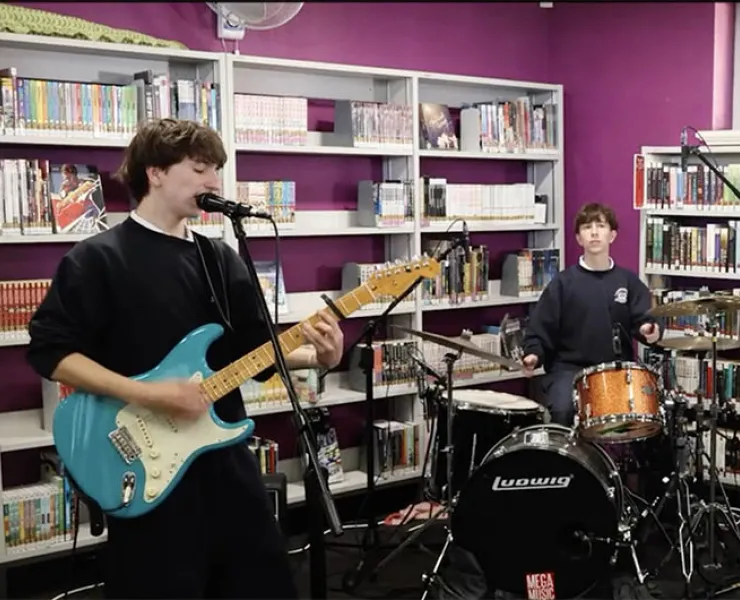
Image: Birdland, Mount Lawley High School
Eligibility
Who can apply
- government primary and secondary schools
- Catholic and independent primary and secondary schools
- school clusters or regional school consortia
- private music academies
- specialist music providers
- TAFEs
- Australian universities
- community conservatoria
- consortia including at least one educational institution
- Registered Training Organisations (RTOs)
- local councils
- music charities and foundations.
The applying organisation must be located in Australia, majority Australian owned, and have been operating for a minimum of two years.
The proposed activity must meet the Music Australia Council’s agreed definition of contemporary music, as follows:
“Australian contemporary music is any genre or subgenre of music currently composed, written, produced by Australians and licensed, recorded, presented, and distributed through commercial and non-commercial activity. For the purposes of Music Australia’s investments, the focus is on musical works that are new, original and relevant to contemporary Australia.”
The intention of this fund is to invest in programs that enable equity of access to songwriting and recording initiatives. Well-resourced organisations or institutions seeking investment in established programs where equity is not considered will not be a priority for investment.
Music Australia encourages applications where two or more collaborative partners will work together in a meaningful and relevant way to deliver a program.
Projects may involve collaboration between schools, TAFEs or VET providers, universities, private music academies, music educators, artists, producers and engineers, studios, community and cultural organisations.
Please note: You can submit one application per round to the National Songwriting and Recording in Schools Stimulus.
Who can’t apply
You can’t apply for this grant if:
- you do not have an ABN
- you are an individual or group
- your organisation is a trust or partnership
- your organisation is not based in Australia
- your organisation has been operating for less than two-years (from the ABN registration start date)
- your organisation is currently in receipt of multi-year investment from Creative Australia through the National Performing Arts Framework, Four-Year Investment or Delivery Partnerships
- your organisation is currently funded by the Australian Government through the national arts training organisations (Arts8) program
- you are a radio station (community or commercial, terrestrial and digital)
- you are a record label, distributor, or music publishing company
- you are an artist management company
- you are a concert promoter or festival
- you are a live music venue
- you are a music media organisation
or any combination of the above.
If you are an entity listed above, you may be included as a member of a consortia that is led by an eligible organisation.
You may be eligible to apply for Arts Projects for Organisations, please contact Artist Services to discuss.
What can be applied for
All activities must be for a primary, secondary or tertiary student cohort.
- Songwriting workshops, residencies and collaborative labs.
- Recording, production and demo creation programs.
- Mobile or pop-up recording studio programs.
- Curriculum-aligned programs linking composition, performance and production.
- School-based, after-school, holiday or intensive pathway programs.
- Projects that connect songwriting with music business, copyright, licensing, metadata or music release knowledge.
- Teacher and mentor professional development as a component of the songwriting or recording program.
- Co-teaching or artist-in-residence delivery models, including opportunities for emerging or working composers, songwriters, producers and engineers.
- Learning resources or delivery frameworks as a component of the songwriting or recording program.
- Bridging programs between high school and TAFE, university or private academies.
- Micro-credential songwriting and recording courses for secondary or tertiary students.
- Local or digital listening sessions as a component of the songwriting or recording program.
- Bilingual or culturally specific songwriting programs.
Projects can be delivered in schools, on campus, online, in community or other settings, or through blended delivery models. Where programs are delivered in regional or remote settings, priority will be given to delivery by locally based teachers, mentors, producers or artists.
Eligible costs include:
- teacher, artist, producer, engineer, mentor and other staffing fees
- teacher backfill and release time directly related to the project
- studio/venue hire or mobile recording setup
- equipment hire necessary for program delivery
- curriculum or resource development tied to the program delivery
- project co-ordination, administration and other running costs
- promotional and marketing costs (proportional to the main program costs)
- travel and accommodation costs
- insurance costs directly related to the program delivery
- access and participation costs.
Access costs are legitimate expenses and may be included in your application. We encourage applicants to ensure that their work is accessible to everyone. Budgets may include costs associated with making activities accessible to a wide range of people (e.g. using Auslan, translation to other languages, captioning, audio description, temporary building adjustments, and materials in other formats).
If you are a d/Deaf applicant, an applicant with disability, or are working with d/Deaf artists/students or artists/students with disability, you may apply for access costs associated with the use of an interpreter, translation services, specific technical equipment, carer, or support worker assistance. Please contact Artists Services to discuss your specific needs.
What can’t be applied for
- existing staffing and staff benefit costs
- capital building works or building upgrades
- purchase of music equipment/hardware
- performance tours or one-off showcases without songwriting, recording or learning outcomes
- commercial activity with no clear educational benefit
- activities that do not have appropriate child safety, consent and governance arrangements where relevant
- activities engaging with First Nations content, artists and communities that do not adhere to our First Nations Cultural & Intellectual Property Protocols
- activities that do not have a contemporary music focus.
- fees relating to grant writing or preparing the grant application.
- legal costs
- expenses that have already been incurred
- the same projects or activities you are applying for via other Music Australia or Creative Australia programs.
Protocols
Your application must comply with the following Protocols. We may contact you to request further information during the assessment process, or if successful, as a condition of your funding.
Protocols for using First Nations Cultural and Intellectual Property in the Arts
All applications involving First Nations artists, communities or subject matter must adhere to these Protocols, provide evidence of this in their application and support material. More information on the First Nations Protocols is available here.
Commonwealth Child Safe Framework
All successful applicants are required to comply with all Australian law relating to employing or engaging people who work or volunteer with children, including working with children checks and mandatory reporting. Successful organisations who provide services directly to children, or whose funded activities involve contact with children, will additionally be required to implement the National Principles for Child Safe Organisations.
Budget & Matched Funding
You must complete the budget in the application form showing the grant request and the organisation’s matched funding contribution.
- The minimum grant request is $5,000 and the maximum grant is $100,000.
- If the songwriting/recording program already exists, your grant request must be in addition to the existing budget - increasing, extending or enhancing current activities (e.g. it is increasing the number of students or locations it is run in).
Expenses
You can select a single project or multiple projects in the budget depending on your activity. How and whether you choose to group activities by project is up to you.
You may divide your budget into sections by opening additional ‘Projects’ from the drop-down box in the budget section of the application form. If your application includes multiple components, please open additional ‘Project’ expense groupings by selecting the number (up to 5) from the drop-down box in the application form.
The total amounts in the 'Expense amount' column should be double the total listed in the 'Music Australia covers how much of this expense' column. The expenses in each of these columns don't have to be evenly split.
Matched Funding
You must match the Music Australia grant amount you are requesting on a 50:50 basis. The organisation’s contribution must be cash, not in-kind, and be clearly detailed in the budget in the application form.
- Use the description box to list the support material provided as evidence of the matched funding.
If the organisation is awarded the grant, it is expected that the total project expenditure will be at least double the total grant amount, and this must be shown on acquittal.
You cannot use in-kind (non-financial) contributions or wages of existing staff as matched funding.
What do we mean by ‘matched funding’
The organisation must invest equal to the funding request to Music Australia. For example, if you request $60,000, the total project budget must equal $120,000.
You must provide evidence of your matched funding in your support material. If you do not provide this, your application may be ineligible. Please see the list below for examples of evidence you can provide. Please contact Music Australia if you have any questions.
Evidence can include 1 or a combination of the following documents and cannot be more than 2 years old:
- statement of past or projected enrolment fees, or voluntary contributions
- available bank balance (provide a document or screenshot of the account balance and account name – removing other personal/sensitive and transaction details)
- other local, state or federal government grants
- crowd funding (including Australian Cultural Fund generated income)
- investor contributions
- profit and loss statement
- copy of audited financial accounts.
Support material
You must submit support material with your application. The assessors review this support material to gain a better sense of your organisation and project.
Our preferred method of receiving support material is via URLs (weblinks) that link to content that is targeted and relevant to your application.
Our assessors will not access any URLs that require them to log in or sign up to a platform. Please do not provide links to Spotify or other applications that require users to log in or pay for access.
If you are linking to media files that are private or password protected like Vimeo, please provide the password in the password field on the application form.
Other accepted file formats
If you cannot supply support material via URLs, you may upload support material to your application in the following formats:
- video (MP4, QuickTime, and Windows Media)
- audio (MP3 and Windows Media)
- images (JPEG and PowerPoint)
- written material (Word and PDF).
It is the responsibility of applicant to ensure that support material formats, (weblinks and files) are accessible and working in their submission. Music Australia will not contact applicants if assessors are unable to access support material.
We do not accept application-related support material submitted via post. Application-related material received by post will not be assessed and will be returned to the sender. If you think you will have difficulty submitting your support material online or need advice on what type of material to submit, please contact Music Australia.
There are limits to the amount of support material you can submit as a part of your application. Assessors may not view or read support material that exceeds these limits.
You MUST include the following support material for your application to be eligible:
- Evidence that your funding request is additive to your existing program if applicable. This may include a link to a program website, annual report or written document outlining how this funding will enhance or increase your program.
- Evidence of matched funding (see Budget & Matched Funding above for examples)
- If relevant to your activity, letters of support must provide evidence of appropriate permissions and support from First Nations organisations, communities, and Elders. Please refer to the First Nations Protocols for more information.
You may also provide:
- program and organisation support material such as links to an organisation website, program overview, and governance structure.
- biographies of key personnel and collaborators involved in the activity (no longer than 2 A4 pages in total)
- letters of confirmation from collaborators directly involved in the activity (with each letter not exceeding one A4 page)
- letters of support (up to 2). These should not be from individuals or organisations directly benefitting financially from the activity.
- A risk management plan. If you require a template, you can download a template here)
Assessment
Assessment Criteria
Applications to the National Songwriting and Recording in Schools Stimulus will be assessed through Industry Advice. Final decisions will be made by Music Australia based on this advice.
Learn more about how we assess your application.
Industry Advisors will review your application using the three criteria below.
Under each criterion are bullet points indicating what advisors may consider when assessing your application. You do not need to respond to every bullet point listed.
Quality
Industry Advisors will consider:
- whether the program has strong creative and educational/pedagogical design, and is age-appropriate
- the artistic merit of the program
- the experience, skills and reputation of the organisation/s and people involved in delivering the activity
- the use and strength of partnerships and collaboration
- whether the activity aligns creative ambition with relevant curriculum and educational standards
- whether the program is well designed with clear learning, creation and/or pathway outcomes.
Impact
Industry Advisors will consider:
- if the program is run by locals and builds ongoing community capacity
- whether the project addresses access and equity gaps
- the opportunity for students to gain a next-step opportunity, outcome or pathway across music education and industry settings
- whether the program leaves teachers, mentors, institutions and communities stronger, with increased capacity, resources and replicable models after the funding ends
- whether the program establishes or builds on meaningful collaborations between delivery partners such as schools, TAFE/VET providers, universities, music academies, artists and music professionals, community and cultural organisations
- whether the program creates a pathway for emerging or working composers, songwriters, producers and audio engineers to share their knowledge and build their capacity
- the number of participants that will be positively impacted by the activity relative to the location and context of the program
- number of original songs or compositions produced, and number of recordings completed.
Viability
Industry Advisors will consider:
- whether the application clearly identifies the need or opportunity and explains why the project is important in its local, institutional or sector context
- if the project has a realistic budget and timeline, and represents value for money
- whether the budget is additive - increasing, extending or enhancing current activities (if the songwriting/recording program already exists)
- the organisation’s matched funding contribution, and whether evidence is provided in the support material
- the experience, skills and reputation of the people involved in delivering the activity
- the governance of the organisation/s involved
- the strength of the proposed partnerships and collaborations
- whether First Nations protocols, consent, child safety and IP addressed appropriately?
- whether the program meets the National Principles for Child Safe Organisations
- whether there are clear, age-appropriate plans for IP, consent, ownership, credits and use of recordings.

We acknowledge the many Traditional Custodians of Country throughout Australia and honour their Elders past and present.
We respect their deep enduring connection to their lands, waterways, and surrounding clan groups since time immemorial. We cherish the richness of First Nations peoples’ artistic and cultural expressions. We are privileged to gather on this Country and to share knowledge, culture and art, now and with future generations.
