
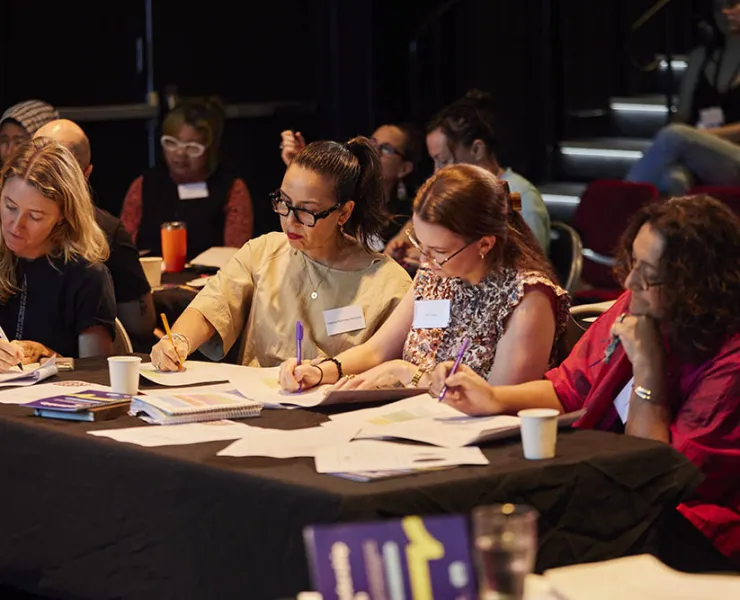
Leadership Skills Workshops
Key dates
Expressions of Interest close: Tuesday 29 September, 3pm AEST
Notification: Thursday 1 October
Details
Workshops take place over 2 days, in-person, 9am-5pm local time in:
Brisbane: 15-16 October
Canberra: 29-30 October
Hobart: 5-6 November
Melbourne: 19-20 November
Contact
If you have questions, you can book a time to speak with us.
You can also contact the Leadership Capability Team: leadershipprogram@creative.gov.au or find other ways to contact us.
Please note: This program is open for expressions of interest. You must complete this form to express your interest.
About the opportunity
Leading Teams, Others and Yourself is a two-day, in-person leadership skills workshop. This opportunity is for mid-career and established leaders and managers working in arts and culture organisations in Brisbane, Canberra, Hobart and Melbourne. There are 30 places available in each city.
| City | Dates | Venue |
| Brisbane | 15-16 October 2026 | State Library of Queensland |
| Canberra | 29-30 October 2026 | Ainslie Arts Centre |
| Hobart | 5-6 November 2026 | Moonah Arts Centre |
| Melbourne | 19-20 November 2026 | Collingwood Yards |
Leading in arts and culture means making decisions that affect people’s work and the communities your organisation serves, usually with less time and money than the job needs. Some come to leadership through study; others learn it on the job. Either way, leading is a set of skills that can be built.
This two-day in-person workshop is for people who lead teams and hold responsibility for decisions, with breakout sessions covering:
- working with boards, funders, partners and teams to deliver change you can’t create alone
- the first 24 hours of a crisis, the hard conversations, and the repair afterwards
- making strategic decisions when the urgent work fills every day
- building leadership capacity in the people around you, so the work doesn’t stall when you step back.
You will work on live challenges from your role alongside peers from across the sector. You will leave with tools, a tested plan and a time to check in on progress with a peer.
This opportunity responds to skills gaps identified through sector consultation with Creative Australia for the Creative Workforce Scoping Study. The workshops have been co-designed with Creative Australia and delivered by Portable, a design practice working across justice, health, education, the public sector and the arts. Portable consulted with The LOTE Agency, People with Disability Australia and Buledya on the design and content of the workshops.
Watch the information session
Leadership Skills Workshop Information Session
Eligibility and expressing interest
Who can attend
You must meet all the eligibility criteria below:
- you are an individual working at least 0.5 FTE in an Australian arts and culture organisation and,
- you manage a team of 2 or more staff (incl. part-time employees and contractors) and,
- your organisation has an annual turnover less than $40 million based on your most recent audited financial statements (2024-25 or 2025-26) and,
- your organisation currently receives less than $5 million in annual funding from Creative Australia through National Performing Arts Partnership Framework, Multi-Year Investment, Visual Arts, Crafts and Design Framework or Delivery Partner programs.
Only one person per organisation can attend the workshops.
Who can’t attend?
You can’t apply to this opportunity if:
- you cannot attend the 2-day in-person workshop in full
- you or your organisation has an overdue report for a Creative Australia grant or opportunity
- you or your organisation owes money to Creative Australia
Please note that only one person per organisation can attend the workshops to ensure equitable access.
How to express your interest
You can express your interest in attending a workshop by completing this form.
You can express interest to attend only one of the 2-day in-person workshops, which must be your closest workshop geographically. We cannot provide travel support. Each workshop is designed to respond to the context of the location it is delivered in.
The form will ask for:
- your contact details
- information about your organisation
- dietary requirements
- access requirements
- your preference for breakout sessions
If you are offered a place in the workshops, you will be able to adjust your breakout session preferences on the day of the workshop.
Choosing your breakout sessions
There are four breakout sessions and you must attend two of them, one each day.
| Session | Choose this session if | You will leave with |
| Bringing people with you: negotiation and influence | You are working on a change that involves other people: a board, a funder, a partner, a team, a community. You want to be more deliberate about how you bring them with you. | A completed relationship and influence map, one named next move, an understanding of the different ways to influence, and a version of the tool you can use with your own team. |
| When it goes wrong: the first 24 hours, the hard conversations and repair | You have been improvising your way through crises and hard conversations, and you want a tested sequence to follow instead of instinct. | A 5-step sequence card for the first 24 hours, one practised regulation technique, a repair sequence card, and a team version. |
| Strategic decision-making: moving beyond reaction and working with constraints | The reactive work fills your day, all of it is genuinely urgent, and next year is starting to look exactly like this one. | A completed fortnight audit with your ratio, a start, stop and do not start list, a triage rule card, a designed strategic rhythm for the next month with a named trade, and a team version. |
| Not carrying it alone: building a culture of shared leadership | Your organisation slows down or stops when you do, and you want to change how it is built rather than work harder. | A dependency audit with named potential holders, a written map of who holds what for one real piece of work as it is and as it should be, two commitments about your own behaviour, and a critical friend arrangement with a named person. |
Access support
We are committed to providing equitable access for d/Deaf and disabled leaders to these workshops.
When you complete the expression of interest form please tell us if you have access needs. This could include Auslan interpreting, captioning or other services to support you. If you are selected to attend the workshops, we will contact you to understand what you need and how we can support you. We will cover costs associated with agreed access services you might need.
If you consent, we will also share your access needs with Portable so they can provide necessary adjustments.
Financial support for access costs
If you are a d/Deaf and/or disabled leader and have additional access costs so that you can participate in these workshops, you can request up to $1,000 to support those costs. This might include costs that you need to manage yourself such as engaging support workers or transport to and from the workshop venue.
You can tell us about your request for financial support in your expression of interest form. If you are offered a place in the workshop, we will contact you to discuss your needs and how much funding we can provide.
Selection process
Creative Australia staff with diverse and relevant experience will review the expressions of interest against the moderation criteria listed below to ensure equitable access for both individuals and the organisations they work in.
There are up to 30 places available at each workshop.
Moderation criteria:
- organisation size
- art form
- location
We also consider information you provide about how you identify, where provided, to ensure equity and representation that reflects the sector.
What happens after you express interest?
We will notify you on Thursday 1 October if your expression of interest has been accepted and send you pre-workshop information and preparation activities. This will include up to four pages of reading or 30-mins of watching and a self-assessment activity – a total of around two hours of preparation.
We will keep a list of reserves in case places become available. We will offer reserve places no later than two weeks before each workshop.
If you are selected and you can no longer participate, you must notify us as soon as possible, with at least two weeks’ notice via email before your scheduled workshop.
More about the workshops
What will I learn?
The models shared in workshop are evidence-based, drawn from established leadership and organisational psychology research. Models are taught as tools to test and adapt against your own experience.
Everyone starts with the same two foundations on the first morning: the four leadership behaviours that hold up under pressure, and the states people lead from. These are the shared concepts that will inform the rest of the workshops. You will return to both foundations on Day 2 to review your self-assessment.
You will then select from two of the four breakout sessions that deepen your skills in specific areas. Each breakout session teaches one core idea and runs one practice activity, so you leave able to use practical tools and approaches in your own work.
The four breakout sessions (of which you will select two) are:
- Bringing people with you: where your power actually comes from, and how to map, influence and move change you can’t deliver alone
- When it goes wrong: a sequence for the first 24 hours of a crisis, staying steady under pressure, and repairing a working relationship afterwards
- Strategic decision-making: auditing where your time goes, triaging demands with a rule, and designing strategic time into your month
- Not carrying it alone: building a culture of leadership in your organisation, and redesigning who manages what.
See above, “How to express your interest,” and below in the FAQs for more detail on the breakout sessions.
How can I apply the learning in my work or practice?
You work on your own real challenges throughout the workshop, and what you learn over the two days is usable straight away. You will leave with printed tools from each of your breakout sessions: maps, sequences, audits and reference cards you can use again with your team.
You will finish on Day 2 by writing one commitment for the next four weeks, testing it with another participant before you leave. You will also pair up with a peer and make time to check in with them two weeks later. There is also an optional online group check-in facilitated by Portable 2-4 weeks after the workshop.
Workshop schedule
2 weeks before
You’ll receive a Welcome Pack that includes:
- venue and access information,
- a short self-assessment of your confidence and ability in leading, which is the baseline for measuring changes
- an optional primer on the two foundations, as audio or video with captions and transcript
- summary of shared principles for effective learning, and
- outline of the four breakout sessions.
Day 1
| Time | Session | What you will do | |
| 9am | Acknowledgement of Country | ||
| 9.30am | Opening: what leadership looks like now | Set out your own definition of leadership, the one that fits your style, your work and where you want to go next, before anything new arrives. | |
| 10.20am | Setting up the room together | The facilitators set out how they will work, then you add what you need to learn well. | |
| 10.45am | Morning tea (20 mins) | ||
| 11.05am | Foundation 1: leadership behaviour under pressure | Explore the Four Pillars: leadership behaviours that hold up under pressure, made concrete against your own last fortnight. You will work out which of them you reach for when the week gets hard, and which one goes first. | |
| 11.45am | Foundation 2: the states we lead from | Explore the states people lead from: the ones that open a situation up and the ones that close it down, and what moves a person between them. You will learn to recognise your own signs early enough to do something about it. | |
| 12.25pm | Into your breakout sessions | See how the morning connects to each breakout session, and write down the challenge you are taking in, so you arrive with real work to do. | |
| 12.45pm | Lunch (45 mins) | ||
| 1.30pm |
Breakout sessions Choose one |
Bringing people with you: negotiation and influence | When it goes wrong: the first 24 hours, the hard conversations and repair |
| 2:55pm | Afternoon break (20 mins) | ||
| 4.30pm | Day 1 close | Name the one thing you will use, and pair up with someone who took the other breakout session for reflection and sharing. | |
| 5pm | Finish | ||
Day 2
| Time | Session | What you will do | |
| 9.15am | Opening and pair check-in | Reconvene with your pair and name what has settled overnight. | |
| 9.50am |
Breakout sessions Choose one Includes Morning Tea break (20 mins) |
Strategic decision-making: moving beyond reaction and working with constraints | Not carrying it alone: building a culture of shared leadership |
| 12.25pm | Lunch | ||
| 1.35pm | Teach one tool | Teach one of your tools to a small group who did not attend your streams and learn theirs. You leave having taught something and learned about one tool from all four breakout sessions. | |
| 2.35pm | What you understand differently | Return to the content covered in the Foundation sessions from Day 1, rate yourself again, and name what has changed. You will see the shift, not just the score. | |
| TBC | Afternoon break (20 mins) | ||
| 3.40pm | Your action and accountability plan | Write one specific, dated commitment for the next 4 weeks, then test it with a peer. Exchange plans with your peer pair and book your 2-week check-in before you leave the room. | |
| 4.35pm | Close | Final reflections and complete a short feedback form. | |
| 5pm | Finish | ||
2 weeks after
Check-in with the participant you paired up with, booked before you leave Day 2. You run this yourselves.
2-4 weeks after
An optional small-group session with other participants, led by Portable and offered by city.
4 weeks after
Complete a reflection on what you’ve applied, plus the same self-assessment you did before the Workshop so that change can be measured. This final reflection completes your participation in the program.
About the facilitators
Portable
These workshops are designed and delivered by Portable, a B Corp research and design practice working across justice, health, education, the public sector and the arts.
Portable was a key delivery partner on Creative Australia’s Creative Workforce Scoping Study, working with 111 people across 13 focus groups and five roundtables in every art form sector. Leadership and management skills came up as a gap in nearly every one of them. These workshops are one response to what people said.
Portable has also built co-design capability with Creative Victoria alongside practitioners from film, design, literature, music and visual arts, and runs leadership and capability programs with organisations including the ABC, Australian Red Cross, headspace and the National Disability Insurance Agency.
Kathryn Foster
Head of People and Culture, Portable (she/her)
Kathryn Foster is a registered organisational psychologist and Portable’s Head of People and Culture, with a Master of Psychology (Organisational). She has spent 20 years designing and running leadership programs across government, not-for-profit and corporate organisations, and has worked with more than 400 leaders. Her focus is learning that changes what people do rather than what they know. Kathryn led the design of these workshops and facilitates both days.
Joe Sciglitano
Creative Director, Portable (he/him)
Joe Sciglitano is the Creative Director at Portable. He has led teams of designers and creatives, and facilitated design and leadership capability work with Creative Victoria, the ABC, Australian Red Cross, headspace and the National Disability Insurance Agency, and holds training in conflict resolution, neurodiversity inclusion, and Aboriginal and Torres Strait Islander cultural awareness. Joe worked as a commercial illustrator and visual designer in the performing arts before moving into design.
Frequently asked questions
About the workshops
Who is this program for?
These workshops are for people in arts and culture who lead teams, make decisions and carry responsibility for how the work gets done. That includes heads of organisations, and people who hold genuine leadership and management responsibilities. Whether you came to leadership through study or through the work itself, the two days are about getting better at it.
You will get the most value from attending if you need to lead, collaborate with and guide others, such as a team, a board, an advisory group or partners. If you are looking for skills development that will help you be proactive and not reactive, this workshop is for you.
What can I expect from the learning environment?
A room of up to 30 people from across arts and culture, two facilitators, and clarity about the learning environment. You will not be asked to present to the whole group or called on to answer questions. You can leave at any time without explaining why.
The workshop is designed to help you practice what you learn on real problems. The invitation is to do real work on real problems during the two days.
These are capability workshops rather than a support group or a debrief. While you are invited to bring your real challenges, this is for the purpose of learning new skills. If you need support with something difficult right now, this will not be the opportunity for you.
What research, methods and frameworks are referenced in the workshops?
The models come from established leadership and organisational psychology research, alongside practitioner work widely used in organisations. Some sessions teach a published model directly. Others use tools Portable has built, drawing on the research below. A full reference list will be provided to participants. Portable have adapted these models to suit this cohort and share them as tools to add to your effective leadership toolkit, not the only approach.
Foundations covered at the start of the workshop:
- the four leadership behaviours that hold up under pressure, drawing on Peter Hart and Peter Cotton's research on team culture and morale, applied here to your own leadership practice
- the states people lead from, drawing on the work of Peter Muling, Peter Hart and Roger Dingle. We have kept the structure of this model and rewritten the language to suit our context.
The four breakout sessions (of which you will select two):
- Bringing people with you: John French and Bertram Raven's work on the sources of social power, and Gary Yukl's research on influence tactics. You'll leave with a clearer read on where your own power comes from and how to bring others with you.
- When it goes wrong: a sequence Portable has built for the first 24 hours, drawing on crisis management research from Timothy Coombs, and Karl Weick and Kathleen Sutcliffe. You'll also leave with a repair sequence informed by Roy Lewicki and Barbara Benedict Bunker's work on trust repair.
- Strategic decision-making: practical tools Portable has built, informed by Leslie Perlow's research on where working time actually goes, and research on protecting focused work.
- Not carrying it alone: shared leadership research from Craig Pearce and Jay Conger, and a critical friend practice drawing on peer coaching research from Polly Parker, Douglas Hall and Kathy Kram.
What will participants take away from the workshop?
An action plan for the next four weeks that you’ve talked through with another participant, and their commitment to check in with you two weeks later. Printed tools you can use again, including a version you can run with your own team. A clearer read on what you do well, and what you can work on next. You also get the handouts for the breakout sessions you didn’t attend.
What preparation is required?
You will receive the welcome pack, a short self-assessment, a one-page reading on your chosen breakout sessions, and an optional two page reading on the foundations, offered as audio or video with captions and a transcript. We anticipate this will take approximately two hours in preparation. We also ask you to bring one real challenge you are working on.
Everything on the day is designed to work if you arrive having read nothing. But the more you invest in the experience, the more you will gain from it.
What should I bring?
One leadership challenge you are trying to make progress on. That might be a change you need people to come with you on, a relationship that has stalled, a decision you keep deferring, or something only you currently know how to do. You will need your work calendar easily accessible for the planning activities. Everything else is provided, and prepared alternatives are available if you would rather not use your own situation.
Am I being tested or assessed?
No – these workshops are about you developing your own skills and using self-assessment to help build your own awareness. Your self-assessment is not shared with Portable or Creative Australia.
Portable will ask you to share your reflections from the workshop which will form the basis of a report to Creative Australia sharing de-identified overall findings to help inform evaluation and future delivery.
How were these workshops developed?
The program has been developed by Portable and Creative Australia, through design sessions and consultation with independent advisors from The LOTE Agency, People with Disability Australia and Buledya.
Is this the same as Leadership Labs?
No, they are different opportunities. The Leadership Skills Workshops are being delivered in Brisbane, Canberra, Hobart and Melbourne for mid-career and established leaders working in organisations.
The Leadership Labs are one-day in-person events in Adelaide and Sydney and open to anyone working in arts and culture.
How will psychological safety be supported?
Difficult content can come up. In a room of people talking honestly about the hard parts of their working lives, what others raise may land close to your own experience.
What is in place:
- facilitators experienced in running these conversations, who name the limits of the session rather than working past them, and who will step out of the room with you if you need to
- a quiet space identified at each venue
- support available across both days from someone who isn’t facilitating
- support services for people working in arts and culture, shared at the start and end of each day.
These workshops are focused on tangible leadership skills development and are not a support group or debrief. We want to be clear about the program parameters before you decide to attend.
About expressions of interest
What does employment at 0.5 FTE (Full Time Equivalent) mean?
Full Time Equivalent (FTE) is a way to measure working hours.
In most organisations FTE is 38 hours per week, but this can vary. If your organisation defines full time as 38 hours per week, then you must work at least 19 hours per week to be eligible for this opportunity. If your organisation has a different FTE, you must work at least half of those full-time hours to be eligible.
Will there be workshops in other cities?
Yes. We will host further workshops in other locations around Australia in 2027. Please subscribe to our e-news for updates.
How can I get help with my expressions of interest?
Our staff are available to help you understand this opportunity and complete the form. We can help over email, phone and video calls You can book a time to speak with us or send us an email to leadershipprograms@creative.gov.au.
Can people working in commercial organisations apply?
Yes, they can. They will need to meet all the eligibility criteria including demonstrating that they are an arts and culture organisation or offer services primarily to the arts in Australia.
Can people working in universities, university departments or local councils apply?
This program is for people working in small, medium and large arts and culture organisations, or organisations that primarily offer services to the arts.
Staff working primarily in Council or University owned arts and culture facilities such as performing arts venues or galleries may submit an EOI. Local council staff who work in general arts and culture roles within local council program or policy areas may not be prioritised.
I am an individual artist / working with a group of artists, can I participate?
This opportunity is only open to individuals working at least 0.5FTE in an arts organisation. An arts organisation is a legally constituted body such as an incorporated association or company limited by guarantee.
I work in the screen industry, can I participate?
Individuals who work in organisations that create or support screen-based art are eligible. Individuals who work in organisations whose main purpose is creating or supporting short film, feature film, television or documentary or electronic games are not eligible.

We acknowledge the many Traditional Custodians of Country throughout Australia and honour their Elders past and present.
We respect their deep enduring connection to their lands, waterways, and surrounding clan groups since time immemorial. We cherish the richness of First Nations peoples’ artistic and cultural expressions. We are privileged to gather on this Country and to share knowledge, culture and art, now and with future generations.
